Right, seeing as I tend to preface these things with a brief history of the artist and I, here’s the skinny on Homme and throughsilver: I have to admit that I wasn’t on at the ground floor with QOTSA. I didn’t get the album on Loosegroove. I in fact waited until 1999 to get the first album because I was (am) a big Kyuss fan and didn’t like the prospect of what Homme admittedly satirically referred to as ‘robotic trance rock’. I got it in the end, and loved it, so it was all good.
I then went a bit crazy (in a good way) and got the EPs, all the Desert Sessions stuff, and went on to buy all their albums as soon as they were released. It was great up to and including 2000, which is when I got the excellent Rated R as well as the fifth and sixth instalments of Desert Sessions, but sadly turned a bit sour by 2002. Songs for the Deaf was a bit mediocre for them; it opened with a Desert Sessions rehash (I generally don’t mind their re-workings, but not to start a new album!), had those annoying ‘DJ’ segments, and pretty much every song seemed to go on a minute or two too long. The less said about Lullabies to Paralyze, the better.
So it was with no small amount of trepidation (and very little optimism) that I bought Era Vulgaris. I had downloaded it, but couldn’t even be bothered listening to it. Still, I saw it in the shop and decided I might as well get it bought. I am heartened to report I was in for a very pleasant surprise. The initial impression the album left on me was that it seemed to be a legitimate progression from the sound Josh had been working with in the late nineties, as opposed to the last album (and, to a lesser extent, the one before that). The strange yet compelling riffs were back, along with that gorgeous guitar tone (that’ll be Chris Goss producing then) and the willingness to throw the listener some aural curveballs – as opposed to that rather homogenised major-label-band sound they had ended up with.
‘Into the Hollow’. So the Lanegan song is predictably good (and I kind of miss it after all we got last time was that lullaby to kick off the album). Only time will tell quite how good a Queens & Lanegan song it is, but I very much doubt it will beat the absolutely serene ‘In the Fade’ on the all-time list. Still, it’s lovely enough to remind me of that balmy summer afternoon in 2000 when I first heard Rated R. Maybe it’s just because it’s June and I’m currently in the same room as I was then. The only real difference is that I am reading Hi-Fi+ as opposed to Too Much Coffee Man.
Overall this does seem to be rather musically braver than the last two albums (admittedly not a hard task to accomplish). The riffs really are wonky and rude, as though the guitars bungee cord had been stretched too tightly in the direction of the mainstream over the last half-decade; it has now snapped back into strange rhythms, a hook-less world, devoid of accessibility yet strangely catchy in its own way. Indeed, the bungee cord has snapped back with such ferocity that it has actually flung the arrangements far beyond the realm the debut inhabited, into the Queens’ own Stone Age. This is not quite Kyuss-heavy, but that is ably compensated by the depth of the mix here. To say there is a lot going on would be an understatement.
‘Make it Wit Chu’. This is obviously a continuation of the grand QOTSA tradition of sticking a Desert Sessions song on their album. I don’t mind this instance, because the song has been sufficiently altered… and they didn’t make the lethal mistake they did in 2002 by opening the damn album with a rehash. This is more of a ‘Monsters in the Parasol’ type of success story, then, but I don’t know whether I prefer this to the original. It’s more sophisticated, definitely, but I love the laidback groove of the best Desert Sessions stuff, and the original has Polly Jean Harvey on it.
3’s & 7’s. I wouldn’t know where to begin with the grammar on here, so I shan’t. This is apparently the lead single and it rather echoes ‘Little Sister’ in its quality-without-ever-threatening-transcendence professionalism. It admittedly picks up about halfway through, so that’s a good thing. The snotty bass fill could even have been played by one Nick Oliveri once upon a time, though this is sadly far from the quality of ‘No-One Knows’ at present.
River in the Road. It’s a shame this one fades out after only three minutes, because its militarily-inspired percussion propels it along in quite the compelling manner.
Running Joke ends just as it’s getting good!
So. The album, at fifty-four minutes, is still a bit too long for my liking, and it’s a shame Homme has forgotten how good albums can be when they can fit on one side of a C-90 (there’s a reason why Jebus made records twelve inches). Despite that, and the ostensible lack of a big finish*/hooky single (probably a blessing in disguise with regard to the consistency of the record), this is easily the most fun QOTSA album to sit through, and potentially also their best album, since 2000. If nothing else, it’s refreshingly pleasant for an old senti-mentalist such as myself to be able to say, with conviction: The Queens are good again!
Your move, Metallica and Radiohead.
P.S. I miss Dave Catching more than I do Nick Oliveri. P.P.S. I am still waiting, with aching heart, for a collaboration with John Garcia, the best singer who ever featured on a Josh Homme song.
And so it was that I watched a metal documentary; now there’s a surprise. For those that didn’t know, I love metal, and I loved the VH-1 series Heavy – The Story of Metal. I didn’t even really intend to watch this one (rather, I had intended to watch earlier episodes, missed them and then sacked it off as a lost cause). Anyway, I had just got done watching The Producers and this was just starting.
The episode itself was enjoyable enough, even if the pearls of wisdom it dropped were common knowledge to anyone with even a cursory knowledge of the genre: Rob Halford’s (ergo early eighties metal’s) look was based on his illicit trips to fetish shops.; he was gay (I still can’t believe people didn’t know. Come on, ‘Hell Bent for Leather’?); Black Sabbath were a bunch of normal blokes; punk rock made metal ‘uncool’, etc.
Far be it from me to suggest that esteemed writer Charles Shaar Murray was in any way plagiaristic with this episode, but the programme watched almost identically to an episode of the earlier VH-1 series; take a look at the blurb for ’British Steel’. Granted, there is not much one can say about the genre at that time, and such an endeavour presents the dilemma of choosing between a programme of insightful information that may not be known to the average viewer, thereby risking complaints about major omissions, or travelling the safe route of presenting the big information in a nothing-new format. Maybe Shaar Murray had something to do with the VH-1 show; that would explain the spooky level of similarity.
However, not only did the programme opt to present the lowest common denominator information, but even then there were some odd omissions*; such as when the transition was made from discussing the workmanlike British metal scene to their more glamorous, partying, American brethren. For some reason, this strain was alleged to have begun in the early eighties, when Mötley Crüe hit the clubs on Sunset Strip. This isn’t even a particularly trainspottery complaint, as the apparent looking away from such massive earlier bands as KISS and Van Halen is a touch absurd. Perhaps they didn’t feel these bands were strictly ‘metal’ but if they weren’t then nor were the Crüe.
Even the VH-1 programme featured the likes of Quiet Riot, but this is perhaps more an illustration of the differences in the metal experience of the two countries in question. KISS was an absolute phenomenon in America, but that success didn’t translate to anywhere the same degree in Blighty. Ditto Van Halen, I suppose. While they certainly predated Mötley Crüe by a clear half decade or so, their success in England only came with the synth frenzy of ‘Jump’ in 1984.
By that token, though, Mötley Crüe weren’t that big over here before then (they didn’t have a top twenty album in Britain until 1987). Meanwhile Quiet Riot – the first ‘metal’ band to reach number one in the US charts – seemed to barely register over here. If they want to keep the content faithful to the British experience, surely it would have been wiser to include Bon Jovi, which was massive in 1986. Pity poor Def Leppard, then: despite being part of the NWOBHM (Iron Maiden was a focal point of this episode), and one of the key players in the late eighties pop metal phenomenon, they were cruelly stricken from the record. Nothing they aren’t already used to, it has to be said, even though their influence on the likes of Andrew W.K. and My Chemical Romance is large and indisputable (certainly the former).
Also odd in its absence was Guns N’ Roses, the band that seemingly single-handedly bridges the gap in mainstream rock between the glam/Hollywood rock epoch and the ensuing Metallica/Nirvana ‘credibility’ era. And their first album was awesome. Maybe they’ll be featured in next weeks ‘Stadium Rock’ episode, but their trashy heroin chic antics would make strange bedfellows with the likes of Bruce Springsteen and U2.
I don’t know if it was a result of time constraints or some larger statement of cultural relevance, but I don’t like the way 1991 seems to signal the end of metal. Sure, the nineties lacked some of the totally mainstream names of the past that are known to all but it would have been nice, rather than perpetuate the myth that ‘then nothing happened’, if they had looked at the metal that followed. There was a narrative strand throughout the episode about how the genre kept getting heavier, faster, more extreme, but there was a definite sense of holding back. Getting heavier and more extreme is fine in the context of the Sabbath-Priest-Maiden continuum, but maybe true heaviness and extremity would have put viewers off. Let’s not listen to Venom, Slayer et al.
But even then short shrift is given to more recent metal. Directly after Metallica making it big with their ‘black album’, we had the emergence of Pantera; arguably the culmination of Metallica’s decision to cut the crap, get more streetwise and move with the times. It’s not like Pantera lacked commercial success either: their 1994 album Far Beyond Driven reached number one in countries around the world and sold millions. Vulgar Display of Power, from 1992, has gone multi-platinum in America alone. It’s just too heavy, too nasty and, possibly key for the subtext of this show, harder to laugh at than the likes of Priest, Maiden and Crüe. Am I being too cynical? Perhaps, but you can’t blame me after ‘metal’ was a dirty word for so long in musical circles.
My larger criticism of this episode is in the inherent hypocrisy of its very existence. Interviewed a few weeks ago on Radio 4’s ‘Loose Ends’ programme, Charles Shaar Murray explained his intention behind starting the series with a ‘year zero’ of 1965 because he wanted to individualise ‘rock music’ as an entity in itself, rather than merely a part of the ‘rock ‘n’ roll’ continuum. Honourable sentiments, perhaps, but that doesn’t explain the ghettoising of metal – itself an individual phenomenon dating back to at least 1970 and still in rude cultural health – as a single, datable, event in the continuum of ‘rock music’. It’s sad that Shaar Murray has seen fit to besmirch metal in order to glorify the rather nebulous ‘rock’.
For what it was, though, the programme was all right. The script didn’t attempt to deride the genre, we got some decent footage out of it (such as excerpts from an Ozzy Osbourne documentary I had no idea existed), and I was entertained for the duration. It was just a bit hamstrung by its own remit: if it wanted to be even slightly comprehensive, going from Black Sabbath to the black album in one move was foolhardy; if it wanted to present an overview of metal as a whole, the looking away from anything that happened after 1991 is a fatal flaw.
* Even the timeline on the website suggests nothing happened between the years of 1982 and 1990 or after 1991.
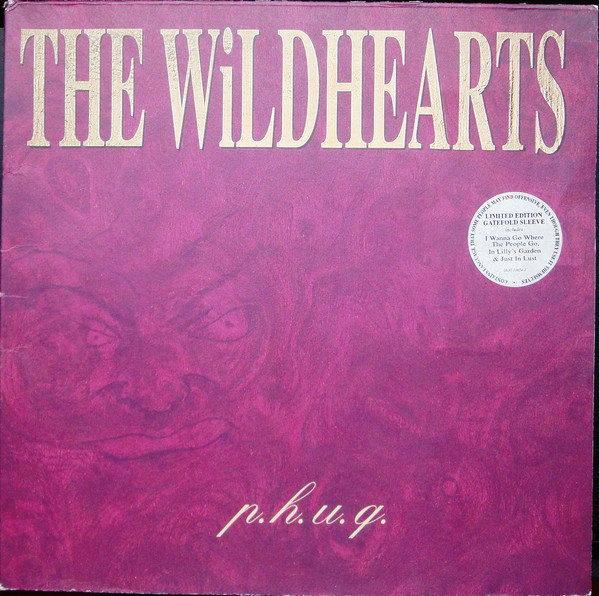
This was the first Wildies album I bought, back in 1995, in a small indie shop while on holiday in Wales. Naturally there was no CD player in the cottage, so I had to wait til I got home to get it listened. I’m pretty sure purchase of this album was preceded by liking the single ‘I Wanna Go Where the People Go’, as I was rather conservative back then and wouldn’t buy an album without a good reason (seriously. I waited until the release of ‘Lithium’ before getting Nevermind).
This was back when rock actually got on teen pop show Top of the Pops; indeed it was back when there was a Top of the Pops at all. Yes, back in this age, it would be no surprise to see The Almighty, Faith No More et al nestled between the stolid non-grooves of Britpop and whoever was the boy band du jour. In fact, I first heard Green Day on the show, but that probably tells you more about my ears distance from the ground than anything else. Otherwise, grunge was over, Britpop was in over here and Green Day and Offspring were the unit shifters in the States. There you go, Tom.
So, while I waited a week to actually listen to the thing, I spent a while looking at the packaging, which was pretty disturbing for an innocent kid like me. In fact, the whole thing seemed rather rude. There was the title (which then Radio 1 DJ Bruce Dickinson always mistakenly called ‘P.H.U.K.’ – still, he loved it. Pretty sure I heard ‘V Day’ on there), and the titles. I know I’m gonna seem like a real non-boy-of-the-world here, but I hadn’t got that many rock albums with swearing in their song titles. As a result, ‘Whoa Shit, You Got Through’ was pretty exciting and, even though I had no idea what it meant, ‘Cold Patootie Tango’ definitely sounded rude. It turns out I was right about that one. And that’s without going into the artwork that featured various grotesques of human faces and, my ‘favourite’, a drawing of a human lower body with a massive head and nose instead of genitalia. Yeah, that wasn’t disturbing at all.
What’s really weird is that, when I finally did get to listen to the album, I liked it far less than I ended up doing so; far less in fact than I do now. I knew it was good, and credible, and that I should like it but, for every anthemic ‘I Wanna Go Where the People Go’, there were more random bits of songs, or strange doom metal interludes. More on this stuff in a bit, but suffice it to say I wasn’t ready.
I was pleasantly surprised to learn this album reached number six in the UK charts, as the Wildhearts are one of those bands whose treatment at the hands of the majors really annoys me to this day. I remember they were actually part of the Sound City gig series that Radio 1 used to put on and, in-between songs, Ginger exhorted the crowd to buy the single and put them up there with the likes of Blur, Oasis and presumably Supergrass or something. And that’s what is really annoying about this album: it should have been absolutely massive; and I mean that about the Wildhearts even more than Kerbdog, because the former had such a knack for catchy, poppy choruses.
I’m not going to do a track by track rundown, because hopefully the Earth vs. The Wildhearts write-up gave you an idea of what the deal is with this band: heavy metal riffs played in a punk rock fashion with the catchiest pop imaginable sung over it. Not only was this approach pretty nearly perfected on this record, but the band branched out in other, slightly weird, directions. Speaking of weird directions, I suppose now would be the time to mention that the band originally wanted this to be a double album.
The Wildhearts were building quite the head of steam by this point (the single preceding the albums release charted at #16), but their label in its infinite wisdom demurred, suggesting this just be the single disc release. In hindsight it all worked out for the best, as the band got to work on the more far-out songs and released them in 1994 to the fan club as Fishing for Luckies (so we get two excellent albums rather than just the one). As I have the 1996 extended release of that record, I’m saving my look at it for after this is done. For those who hadn’t realised, I’m attempting something of a chronological album-based timeline for the band.
In terms of songs, I will mention the first one on the album, the aforementioned hit ‘I Wanna Go Where the People Go’. It seriously would not be hyperbole to suggest it’s a top ten calibre UK single of the nineties. It does everything right, from the teasing intro and massive kick-in to the swathes of glorious backing vocals, bang-on anthemic melodies, returns and sloppy guitar solos (sadly, Mick Ronson had died by this point). I mentioned in the last review that ‘TV Tan’ was the ‘Cigarettes and Alcohol’ of my imaginary parallel-universal meritocracy; this would be the ‘Wonderwall’, combined with the ‘Alright’ and probably also the ‘Parklife’. I’ll let songs like McAlmont & Butler’s ‘Yes’ (pre-Bridget Jones) and all Radiohead singles remain extant, because I’m nice like that.
I bang on about how certain band should have been big, but I can’t escape the feeling that, catchy pop songs notwithstanding, The Wildhearts were just too good to make it particularly big. And I don’t mean that in a bitter ‘you were too pure for this world’ kind of way, as I gently caress their still warm cadaver, but that this album evinces Ginger’s ostensibly inherent knack for turning off the mainstream.
Quite apart from the phallic faces of the packaging, or the fact that their big hit from the album features the line ‘I wanna be where the cunts like me are buried six feet underground’, there are the anomalous songs. Take ‘Baby Strange’, for instance. Yes, it’s catchy, if slightly misanthropic, but it lasts about a minute and ends pretty much halfway through a beat, at which point a real hit that never was, ‘Nita Nitro’ picks up the slack. How about the aforementioned ode to bad sex ‘Cold Patootie Tango’, which sounds like a direct cross between Metallica (down to the ‘Fight Fire with Fire’/’Battery’-style intro) and how Paradise Lost sounded at the time. Sure Pulp and Radiohead were intelligent bands operating at this time in the public glare, but they didn’t have doom metal songs on their albums.
Speaking of Paradise Lost, the majority of P.H.U.Q. employs the same producer that the Halifax gloomsters used on the same years very good Draconian Times, but to even better effect. I sometimes wonder about rock producers, as they are as subject to trend as their ‘electronic’ brethren. So I wonder what Simon Efemy is doing at the moment (as I have Colin Richardson, GGGarth and Andy Sneap in the past), because this is easily the best produced Wildhearts album thus far.
Changes in personnel had little discernable effect on the sound of this album, as Ginger wrote everything, but I shall mention those changes for the sake of completeness. Original members Ginger and Danny McCormack (bass player) remained from the last album, while drummer Stidi had been replaced by Ritch Battersby. The Other Guitarist role was traditionally filled by CJ, but he was turfed out, leaving the band as a trio until Mark Keds (who I originally thought was a woman – bottom right) filled the role for one single in the summer of 1995. The Kedsed-up roster was the Wildhearts I was particularly familiar with due to picking up an issue of Kerrap! magazine on the aforementioned holiday to Wales in the aforementioned summer of the aforementioned 1995. Before Keds, Canadian cult hero Devin Townsend had a cup of coffee with the band and, by the end of 1995, Jeff Streatfield was in place, where he would remain until the band split in late 1997/early ’98.
In terms of overall quality, I’d call this the second best Wildhearts album, but that might be something of a misnomer seeing as the one superior record of theirs was largely written at the same time as this. Still, separate albums they are, so second fiddle this is. Not that such a status is damning in any way, though: that other album (next up on the chronology fest) is absolutely elite leaving plenty of room for quality below.
I consider this album superior to Earth vs. The Wildhearts for numerous reasons, not least the night and day difference in the quality of production. There is greater consistency of quality here, with the Wildies blueprint reaching something of a zenith (certainly on tracks like ‘I Wanna Go…’, ‘Caprice’ and ‘Just in Lust’), married to the newfound sense of variety that led to ‘Baby Strange’ and ‘Cold Patootie Tango’ and spilled over onto their next release.
As the band matured, though, the overt aggression receded accordingly. So while the desire to rock was ever present, it never spilled over into the kind of thrash-influenced mania that songs such as ‘Caffeine Bomb’ and ‘Suckerpunch’ had conditioned fans to expect. In its place was, among other noises, an arguably cynical seam of ballads.
Most cynical, though not to say it wasn’t good, was the psyche-Britpop of ‘In Lily’s Garden’, a song actually mentioned on the hype sticker on the front of the case, but never actually released as a single (good one, East/West!). I’ll readily admit to not liking it for years – I used to just skip it when the jangly chords sounded – but it has grown on me despite its ostensibly cynical genesis (i.e. ‘this’ll be a hit’). In fact, I’d rather it was released and they got their cynical breakthrough hit, as deserved success would be an end justifying such means.
The other ballad was far better, and less of an attempt to capture the zeitgeist, as it was essentially a mid-nineties update of a power ballad: ‘Jonesing for Jones’. As the title indicates, the lyric compared the junkie’s yearning for drugs with the rent heart of the lovelorn. Weirdly (coincidentally?) it is one of two consecutive songs with fade-in intros, along with the closest thing to a ‘Suckerpunch’, titled ‘Whoa Shit, You Got Through’. Though my description may turn some off wanting to hear ‘Jonesing for Jones’, I can assure you that it is a piece of quite exquisite quality, albeit with the sentimentality turned up to full (perhaps moreso for me, as I had my own ‘jones’ for a Jones back in ’95). Nevertheless, it is emotive in the best sense of the word, and a definite highlight of the album.
Of course, some of the songs are not as successful as others. In addition to ‘In Lily’s Garden’, ‘Naivety Play’ is a very competent tune that never threatens greatness. Similar is ‘Be My Drug’, which is largely uneventful save for a presumably unintentional, though dead-on, impression of Therapy?’s Andy Cairns during the chorus.
As with too many albums, these songs fall in the second half, though they are thankfully book-ended by quality. Preceding them is another high point of the album, the excellent ‘Caprice’ (named well prior to the rise of the ‘celebrity’/’model’ of the same name) and energetic closer ‘Getting It’. The latter is followed by the mock-old fashioned sing-along, the untitled but sorta named ‘Don’t Worry ‘Bout Me’, while the former is one of many rhythm based songs on the album – surely something of an anomaly for melodic rock bands – along with ‘Nita Nitro’ and ‘V Day’. In fact, it is this marriage of melodic and rhythmic hooks that imbues the album with such clear songwriting strength.
I was hoping to go into greater detail on the lyrics and musical composition, but two thousand words is probably enough. Besides, I can save that for the next – and both more deserving and musically intriguing – album; the magnum opus, as far as I’m concerned…
I didn’t watch the UK original series of this Danny Dyer vehicle, nor have I seen the film that inspired this whole shebang, The Football Factory. This might actually be less a review of the programme than of my current state of mind on deciding to watch this episode. My excuse is that Dyer was on Radio 4’s excellent Loose Ends today, and I trust what Loose Ends recommends. Apart from that time Jamie T was on.
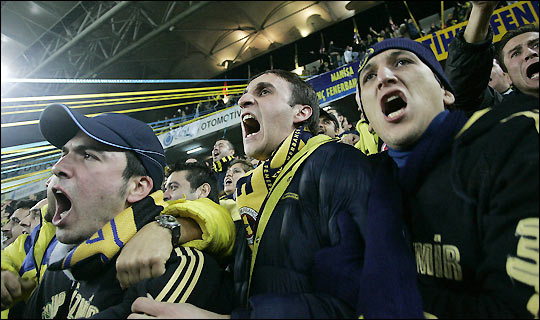
Anyway, I have to admit to something of a ghoulish intrigue felt about the series as a whole; about the kind of thinking that goes on in the minds of football hooligans, about the group/mob mentality that overtakes these individuals come game time. And maybe the anodyne Dyer would poop his kecks. I caught the repeat of episode one tonight, which was based around the massive – and violent – rivalry between Istanbul teams Galatasaray and Fenerbahçe. One thing I did learn tonight was that Galatasaray (the European side of Istanbul) used to be the money club before it was mismanaged into massive debt, while Fenerbahçe, now filled with what Dyer termed ‘new money’, has resurged into pole position in the city.
The premise of the series sees Dyer travel to different countries, ingratiate himself with local hooligan ‘firms’ and film any violence that breaks out at matches. This episode saw him get temporarily ‘in’ with firms representing both sides in the run-up to a derby match between the two. Well, he was more in with Fenerbahçe’s Kill for You firm, as he watched the match in their area and wore one of their delightful white bomber jackets. Seriously, if any of the Galatasaray firm sees footage of this, he should never return to Turkey. Not that he ever would, as he mentioned his abject fear of filming this episode specifically: on account of the two Leeds fans stabbed here in the spring of 2000.
Not that I’m making light of the deaths, because I wouldn’t, but it seems like an odd fear to have. This is a man who feigns being ‘hard’ on the screen, for films and now documentary, actively seeking out what amounts to – if not the scum – certainly some scum of various major cities, and any violence that might surround them. Again, not making light, but people get stabbed everywhere in the world, and I sensed a very weird bit of insincerity in his over-sincerity as he stared right at the camera and gave a dramatic pause when he mentioned ‘the two Leeds fans… who got stabbed’. It was very weird indeed and, if I didn’t know better, I’d think Dyer was actively trying to stir up some tension in British viewers. You know, because documentaries about hooligans fighting each other need a bit of artificially-built drama.
The episode itself was watchable enough, though nobody, from Dyer to the opposing firms, came off at all sympathetic. The Galatasaray firm was painted as the ‘other’ in this binary; Dyer mentioned sensing an air of aggression from them (from hooligans? On the day of a derby? Perish the thought), and their interview was entirely predicated on how their clothing brand was big business, and made money for the club.
The Kill for You firm, meanwhile, was ‘our’ firm. A seated indoor interview with two of the alleged firm kingpins revealed such endearing details as the time one of them attended a derby with Galatasaray-supporting university friends, and how he threw lit flares directly at their heads. Lovely chap. Before the match, Dyer gets visibly drunk to numb his nerves (or poop), and there is some definite awkwardness as the Kill for You-attired Dyer feigns joy when ‘his’ team gains an early lead and eventually wins the match. He was ‘well out of his manor’, apparently.
Rather alarming was the fourth segment of the episode, devoted to smaller clubs’ firms. One club in particular (apologies, their name currently escapes me) made a habit of meeting its firm after each match, at the side of the pitch and accompanied by a Mafia-style firm head honcho. He had his arms round the players as they happily greeted the baying hordes. It was really rather interesting to see how in synch some clubs are with their respective firms.
I’m not sure I’ll be watching this programme too often, as I get the feeling this was the most dramatic (it was the last one filmed of a six week, nine country span) episode of the lot. Dyer certainly went on at length about how he’d never seen anything like it. I presume the rest of the series will just feature shots of him looking hard, asking firms about what they get up to, and acting nonchalant when they tell him. I would tell him to stick to his day job but, having never seen one of his films, I don’t even know if that would be wise. Actually, I might watch the Italy episode; they apparently don’t like the English.


 throughsilver in blog