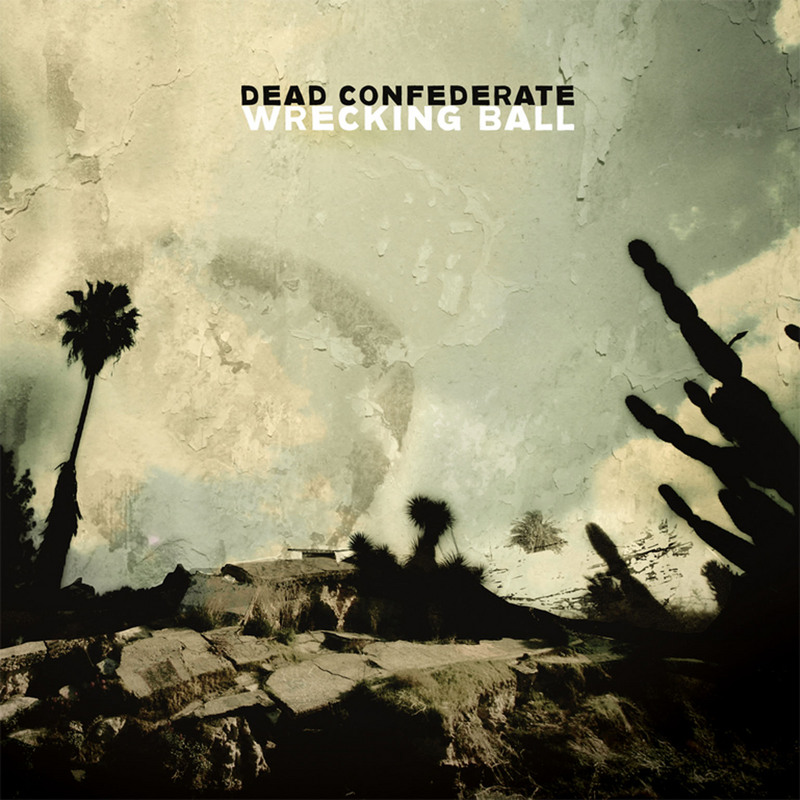
Dead Confederate – Wrecking Ball

Wrecking Ball is good, old-fashioned rock music. Dead Confed being from the state of Georgia (in America, as opposed to the former Soviet republic), the traditionally exaggerated rawk twang doesn’t come across at all exaggerated. The pleasure that comes from listening to opener ‘Heavy Petting’ or single ‘The Rat’ (the latter complete with super-pronounced ‘bang-bueeerrrnng’) is awesomely free from guilt. It’s also devoid of the if-it’s-not-ironic-it-should-be air that hangs over the likes of Wolfmother, Jet or Black Mountain.

A detail worth mentioning is Hardy Morris’ eerie vocal similarity to the late Kurt Cobain: that combination of pure, angelic, voice drowned in anguished grit and growl is far more compelling than the feeble attempts of Bush and early Silverchair, back in the dim and distant mid-1990s. You get the feeling this is not totally coincidental, either, as ‘Goner’ features that near-doom pace, swinging-axe riffing and wolf-trapped-in-snare howl of ‘School’s cry of ‘no recess!’ It’s the kind of song you can see yourself happily listening to, years from now.

Some have compared Dead Confed to Radiohead. Such comparison is not entirely without merit, especially when listening to the widescreen, resigned, languor of ‘Yer Circus’, which aims at a spot near the end of OK Computer, but would fit more comfortably on the cynical, beaten-down Hail to the Thief. Thankfully, though comparisons could be made to Radiohead, Nirvana or even Cave In‘s delightful, spacious Jupiter, there is enough Dead Confederate on show here to suggest this is a band that is more than a grab-bag of influences. ‘Start Me Laughing’s melodic rage might remind a tad of Pearl Jam, but when was the last time that band had this level of urgency? It was a lifetime ago, and this is where the album pays dividends. It’s essentially a (bizarrely southern) Grunge album at a time when most of that scene’s main players are either dead or redundant.

Not only is this album a teensy-weensy bit derivative, but when the band slows proceeds down a notch, as on the lengthy ‘The News Underneath’, the quality dips. Live by the blues-tinged southern rock sword, die by the southern blues-rock ballad, it seems. ‘Flesh Colored Canvas’ is marginally better – it’s aiming more for ‘epic’ than ‘long ballad’, even if it doesn’t quite work – but even longer than the other one. Together they combine for 19 minutes, but it may as well be 19 hours. Or 19 months. ‘Dry County’, by Bon Jovi is a straight-up better long southern ballad (and from a northern band). And that’s without getting into the actually really good stuff, like ‘Tuesday’s Gone’, by Lynyrd Skynyrd, or Ted Nugent’s ‘Stranglehold’.

Luckily, this seemingly contractually obliged balladry is confined to two of the album’s ten tracks; the rest of the record ambles on at a decent pace, with a respectable amount of intensity. This isn’t, as press shots might indicate, the rawest, hungriest sound in rock. Compare it to golden oldies like Zeke, The Cramps, Harvey Milk or early Mondo Generator, and Wrecking Ball’s pop sensibilities are suddenly evident. It’ll come as little surprise, then, to learn that Dead Confederate were ‘discovered’ by Gary Gersh, the man what brung Nirvana to Geffen Records. Take this record for what is is – a nearly-great collection of well-performed southern rock songs with just enough bark and bite – and you’ll find a real grower. Wrecking Ball rewards repeated listens, and bodes well for the future, especially if they take any inspiration from one-time tour-mates, and fellow Georgians, the Black Lips.

Flyleaf – Memento Mori


Polydor (2009)

There is something to be said for second chances. Upon first hearing Memento Mori, second album from Texan major label melodic metal crew Flyleaf, it didn’t make much of an impression. Or, to be more precise, it made a very poor impression. Their first album, 2005‘s self-titled effort, was quite the concise display of the genre. While it was unlikely to challenge the classics of recent mass-appeal metal – such as Incubus’ Make Yourself or, perhaps more pertinently, Paramore’s Riot! – it was a fun way to pass your time.

Memento Mori, initially at least, was less fun. Its 43 minutes (when we discount the international mix of ‘Again’) were rather a drag, and it didn’t sound like it was a bold step on from the debut, as one might expect from a sophomore album. The guitar, especially, was – as they might say in Texas – mealy-mouthed. Further listens reveal an album more full-blooded than originally suggested. ‘Beautiful Bride’ is a fantastic tune, chugging groove riffs intertwined with a strong, individual, vocal performance. It’s anthemic and dynamic: a vibrant start to the album. The pacing, guitar tone and vocal melodies are reminiscent of the ethereal debut album by A Perfect Circle.*

‘Something’s missing in me’, Lacey Mosley sings in ‘Missing’. While the song-strength holds out at least to the point of this song (admittedly only four tracks in), it’s nevertheless a portent of things to come. As strong as the first half of the album is – somewhere between the first and second Paramore album, (f)emo fans – the second sees the band stagnate somewhat. There are one or two ballads here (‘Set Apart This Dream’, ‘Tiny Heart’), but the prevailing sense of sluggishness is more due to a lack of real inspiration. ‘In the Dark’ brings faster riffing in parts, but it seems a bit too contrived. ‘Now for the faster song’, you can almost hear them yawn. Perhaps this is overly harsh judgement of what is ostensibly smart pacing, but the problem lies in the failure of such pacing to be felt over the course of the album. If you mix speed and ballads in with your mid-paced rockers, the overall effect shouldn’t seem so one-dimensional.

At this point we should broach the subject of Christian rock. As an entity, I don’t mind it as much as many other observers seem to. Bob Dylan’s late-1970s conversion led to his best music of that (post-Desire) period. Chicago doomsters, and noted God botherers, Trouble (they had a record called Psalm 9) were one of the finer metal bands of the 1980s. The greatest album of this decade was about how ‘Texas is the centre of Jerusalem’, and contains comic discussions between God and his devoted, though self-aware, subject. Flyleaf, at this point in their career, are nowhere near that level. Nor are they Stryper. They’re more a kin to POD, whose similarly accessible brand of metal could be listened to without once turning your thoughts to the spiritual.

So is the case with this. Debates over the point(lessness) of religion to one side for the purpose of this review, religion has a centuries-long history of inspiring art. Rather than being defined by, or even inspired by, the religion that precedes Flyleaf (let’s face it: rarely does a band find itself described as agnostic rock, so why the focus on Christianity?), this is a chart rock album like most others. Maybe I’m not listening sufficiently closely. The album’s title is, of course, a reference to divine judgement; the ever-present spectre of death’s possibility. The cover art depicts imminent mortality, and its observation thereof by an implacable, regal, figure. The songs do little to communicate this.

One would imagine, if one were to meditate on a religious rock band, possessed by a fanatical fervour, wondering about the razor’s edge on which we reside; that mortal coil off which we could soon shuffle all too easily… that such music would be imbued with an urgency to justify its faith. Judgement is looming; that point in time we face up to cold evaluation in the harshest light of day. What have you done? What are you doing? What change are you effecting, either within yourself or others? If, at such point the Rapture occurs, how inspired are your listeners? For the Lord Himself will descend from heaven with a shout, with the voice of an archangel, and with the trumpet of God. And the dead in Christ will rise first. Then we who are alive and remain shall be caught up together with them in the clouds to meet the Lord in the air. And thus we shall always be with the Lord.

Or are you simply retreading the musical footsteps taken by Lacuna Coil, The Gathering, Paramore and Evanescence? Using religious imagery, the sounds of sanitised emo-core, guts and viscera hidden away by over-production, and the blind faith of the Christian rock market, to lead you to the everlasting light of the pay window? To create largely agreeable pop-rock is one thing. It’s a fine skill, for which many bands are suitably rewarded. Memento Mori is certainly no worse than the most recent Incubus or Deftones albums. But to dress it up in religious imagery, in mock-heroic robes, and hope titular association with a historical artistic movement is enough to raise it on angels’ wings, is a leap of faith too far.

* A Perfect Circle were, of course, rather opposite in their belief to Flyleaf. ‘How your saviour has abandoned you / Fuck your god, your lord, your Christ / He did this / Took all you had and left you this way / Still you pray’ makes you wonder if there is any intentional influence.

Converge – Axe to Fall


Epitaph (2009)

Massachusetts-based Converge offer a convincing case for best metal band of the decade. Consistently brutal, intense, intelligent and aesthetically astute, they effectively put a lid on the 90s noisecore subgenre with their epoch-defining Jane Doe, in 2001. Essentially a concept album about a relationship gone horribly wrong, it was followed up three years later by the bleak You Fail Me, itself a drained husk after the ‘Bitter and Then Some’ Jane Doe. The more straightforward (save for the exceptional centrepiece ‘Grim Heart / Black Rose’) No Heroes followed in 2006. Though less inspired, it was effective in consolidating the Converge legend.

Now, and not without expectation, comes Axe to Fall. The band’s status has been reflected in the guests on here: Steve Von Till from Neurosis; three quarters of Cave In; all of Genghis Tron, among others. Thankfully, the Converge identity is sufficiently strong to assimilate, rather than be defined by, these guests. You wouldn’t know Cave In play on ‘Effigy’ if someone didn’t tell you. Ditto former Entombed guitarist Uffe Cederlund on ‘Wishing Well’. Thankfully, the songs benefit, whether you notice the personnel or not.

In a reductive sense, it could be argued that Axe to Fall is Converge’s thrash album, after their noisecore (2001), hardcore (2004) and metalcore (2006) records. That would obviously sell their sounds short, but the increase in Kurt Ballou’s staccato riffing and Ben Koller’s new-found fondness for pasting the double bass drum like he’s Dave Lombardo or Gene Hoglan is rather noticeable. First song ‘Dark Horse’ explodes into action, roaring and flexing like Iron Maiden’s Lucozade ad song (‘Phantom of the Opera’, in case you didn’t know) re-written for the UFC era. Indeed, a good portion of the songs on here are brief, violent, attacks on the ears and mind: guitars and drums squalling, spinning and flying off in all directions. Jacob Bannon – sounding incrementally more human through the course of this decade – rants and howls throughout, of revenge, anxiety and dread: ‘I’ll do anything that I can do / To lock the window beasts are climbing through’.

There is counterpoint to the rage and bluster. As with past records, these moments contextualise, as well as break up, the frenzy. ‘Damages’ chips and gnaws away at you, angle-grinding post-noise; a virtuoso Wolf Eyes, by way of Discharge’s ‘Protest and Survive’. Steve Von Till’s grizzled, veteran, Lanegan-esque tones bring melody and variety to the closing stages of album. Like a Neurosis song, ‘Cruel Bloom’ offers the extremes of calm and punishment. Though you know it will kick in with some force, the song does so in a way that maintains the sense of melody and space that makes the track so delightfully ominous.

Concluding ‘Wretched World’ begins with the insistent clicking harmonic of a clock tick-tocking. Mookie Singerman, of New York techno-grindcore band Genghis Tron, sings on this one, and it continues the paradoxically bruising melancholy of that band’s last album, Board up the House. Singerman intones, with far more confidence than in the past, of ‘a broke life’s shattered art’; two bands holding fire for a beautiful finale that at once caps off another brilliant Converge record and whets the appetite for ‘Tron album number three. While the news that this album would feature a host of guests suggested a mess of sounds, and perhaps even career desperation after seemingly exhausting the avenues of hardcore/noisecore/metalcore, it has paid off. Certainly, on this last pair of songs, the guests bring their own sound and identity to the mix, while never detracting from the cohesion of the record. It’s a tribute to a band that keeps developing their sound while never appearing repetitive. In a world of lo-fi and shoegazers, this is rock music in HD.

***

POSTSCRIPT: Yeah, that was a cheesy last line, but I needed a convenient way to finish the review for Fact. Otherwise, I’d have banged on forever about the album. See, I review a fair few things, but rarely do I get asked to write up a band of whom I have been a fan for years. And I know a couple of their albums really intimately, so the temptation was to go super-in depth on the little differences, and what the album means in the grand Converge narrative. Of course, Fact is a very cool publication, whose readers are more interested in minimal house and dubstep. So I have to be careful not to completely alienate them. I mean, if I was writing for Terrorizer or someone, I might be able to do that dorky stuff, but this game’s about trying to read your audience innit. If you can’t read them, they won’t read you. And other cliches. So I’ll probably do the in-depth dork-out stuff when I get with the albums-in-2009 post.

But before I finish, ‘Damages’ really is a classic Converge song. Up there with ‘The High Cost Of Playing God’, ‘You Fail Me’ or ‘Grim Heart / Black Rose’. Seriously good, in other words. And you think this post is nerdy? Just wait for the next one…

Cold Cave: ‘Death Comes Close’

Cold Cave follow their acclaimed recent album with an EP for Matador. Main tune, and album cut, ‘Love Comes Close’ comes close to being really good. But there’s something missing. Our man Wes Eisold used to be in screamy hardcore band Give Up The Ghost. Really good, it was. But times change, and Wes is to be applauded for the stylistic leap he has taken for the Cold Cave project. Only problem is it’s a bit by-numbers (as much as a Michael Gira-fronting-New Order deal could ever be). It’s catchy, and well-made, but a bit karaoke, and lacks that steely inhumanity that characterises the best synth pop. It’s ‘Goodbye Horses’, by way of Flight Of The Conchords’ David Bowie impression.

The other tracks on the EP are far more successful. Killer electro-pop sounds either like robots making music with heart-warming humanity (Kraftwerk, Perrey-Kingsley, Yello) or humans making music with heartless efficiency (everyone else). R&B songstress Cassie got this right on her ‘Me&U’ single, as Eisold does on ‘Double Lives in Single Beds’. Opening like a pop take on Burial’s ghost-bleeps haunting housing estates, its vibrant, broad, synth brush strokes give it a sound of its own.

‘Theme From Tomorrowland’ sees androids dreaming of electric romance in fibre-optic bedsits. There’s even a hint of Springsteen’s escapist fantasy, albeit updated for a digitally nihilistic age, our protagonists singing ‘I don’t know where I’m coming to / And I don’t care if I never ever get there.’ Final track, ‘Now That I’m In The Future’, is the musically darkest song, threatening to suffocate the listener in the shifting sands of cyberpunk excess.

The overall experience is emotionally hollow, but with a strange feeling of science fiction satisfaction, like getting pick-pocketed by a replicant in metallic leggings. ‘The future comes when the past decays’, Eisold observes. Whether this is a reference to his falling out of love with hardcore punk, or to the current trend for faux-naive synth-popsters springing up like so many silicon shrooms, is unknown.