World’s Strongest Man 2019

Your world’s strongest man in 2019: Martins Licis

Okay, here’s the headline: Martins Licis won it.

But what’s behind that? I think this was a really consistent performance that was simultaneously not amazingly impressive, if that even makes sense in this context. I was actually surprised near the end, when he had a nearly insurmountable lead. So, what happened?

Event 1 was the loading race, where you have to carry sacks, anvils and ting to a table. Early on, you’re told that the 2018 winner, Hafthor Julius Bjornsson, has a foot injury. I wonder if that will have an effect? Tom “Brother of Luke” Stoltman won this one, with the terrifyingly efficient Mateusz Kieliszkowski just behind, and Martins Licis third. Favourites Brian Shaw and Thor were 8 and 7 respectively. Why did I write their names in that order? Who knows. Veteran JF Caron was good, mind.

Most impressive: Tom Stoltman

Overhead press (medley), next. Lifting a bunch of things over your head, including the massive log of doom. Thor and Shaw this time showed their mettle and smashed it. This was where Georgian Konstantin Janashia smashed his arm up. Licis was really good, but Kieliszkowski was once again terrifying. He just chucked the weights over his head like the swot in class thrusting their hand up when the teacher asks a question. Key line of commentary: “WHAT WAS THAT ALL ABOUT?”. Kieliszkowski, Licis, Shaw and Thor comfortably ahead of everyone.

Most impressive: Mateusz Kieliszkowski

Event 3 was squat lift. 340KG, for the love of god. I’ve done 5 reps of 100KG, I think. Thor staggered about quite early in his reps, and just chucked it after he’d had enough at 7. This is when we learn they wear corsets to keep their back straight. Shaw did 8, and chucked the bar slightly less violently than the fainting Thor. Licis got 9, and looked like his face might explode. He went at a decent pace, and is built a bit squat for a WSM contender. Kieliszkowski went down too strongly on his squats and got 7. His face was even more explodey.

Most impressive: Martins Licis

Event 4: Deadlift (hold). 320KG this time. How long can you go? Shaw shat the bed a bit at 30 seconds, whereas Thor went into a trance for 45 seconds. The fall of Mateusz Kieliszkowski continued, as he placed sixth. Licis a respectable second, after his training from GRIP MASTER ODD HAUGEN.

Most impressive: Thor

Last event was the god damn Atlas stones. Of course it was. First key story was Tom Stoltman beating Shaw in the head to head, though they both struggled on the insane last stone. Thor obviously did them like he was putting the shopping on a conveyor belt. Licis by this point seemed so far ahead that he just had to complete, and he won. Licis pipped Thor timewise (both under 30 seconds), then Tom S, Kieliszkowski and Shaw (under 40), then everyone else.

Most impressive: Thor

I need to say that even though I’ve not mentioned him much, JF Caron was such a great dark horse contender throughout. Didn’t dazzle at any time, but was a tough match for anyone. As for Kieliszkowski… man, his presses were amazing, but I think if you want to be the strongest man in the effing world, you need squats and deadlift. I mean, come on! Thor, bad foot and all, had a great finish but it was too little too late. Licis performed consistently well throughout, only really being amaze in one event, but everyone else’s inconsistency meant he was largely unchallenged in the final reckoning. Well done him, but you know what I mean?

  1. Martins Licis – 46
  2. Mateusz Kieliszkowski – 38
  3. Hafthor Julius Bjornsson – 37
  4. JF Caron – 31
  5. Tom Stoltman – 30
  6. Brian Shaw – 30
  7. Luke Stoltman – 20
  8. Trey Mitchell III – 18
  9. Adam Bishop – 15
  10. Konstantine Janashia – 7 (obv DNF)

So yeah, we’ll see if Thor wrecks everyone if he gets healthy next year. Tom Stoltman was the best Brit, but a bit distant given how many British contenders there were. He has a lot of potential, being close in size to Thor and Shaw, and a don at stones. My main thing for 2020 is wondering if Kieliszkowski can overcome his squat and deadlift issues, or if they are the kinds of lifts that you’re either fundamentally good at or not. Should be interesting. And a glass raised to Laurence Shahlaei, who bowed out with injury in his final WSM. Ledge.

UFC 243

This was a fun show. Thankfully the two main events were really good rather than just “fun”, as two Kiwi fighters did the biz, and outclassed their very capable opponents.

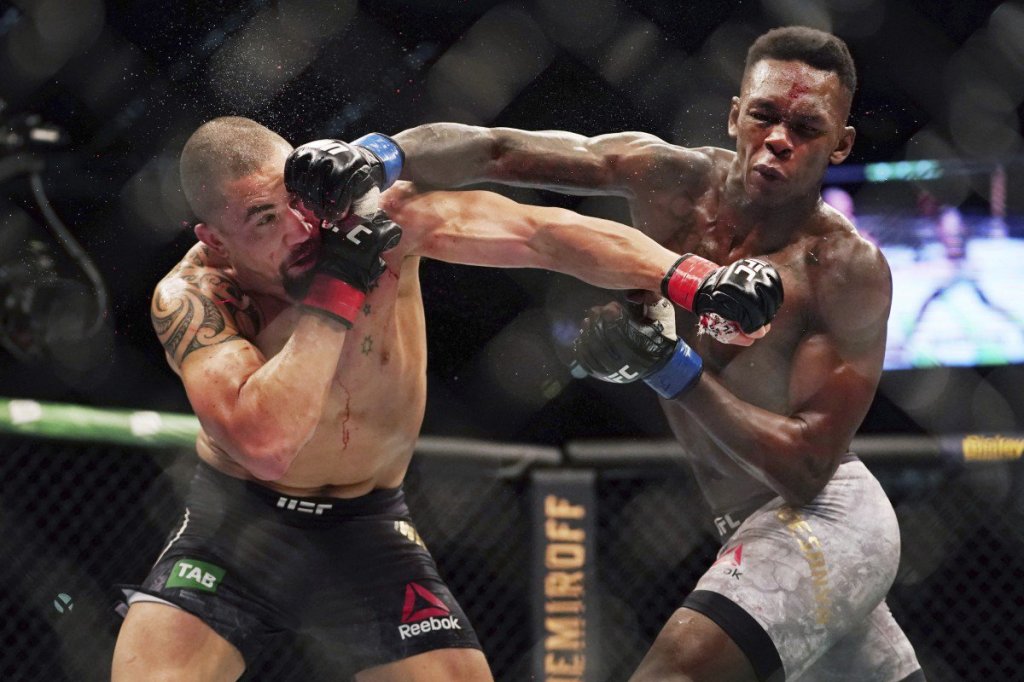
The main event fights were quite similar to each other, in that you had a rangy, lean New Zealander using his reach to pick off his more – let’s face it – workmanlike opponent. The most impressive was, rather predictably, Israel Adesanya, who has made a career of flamboyantly beating the tar out of less virtuoso opposition.

What was really impressive was the fact that his schlub this time was the rather excellent Robert Whittaker, who was the defending champion and had beaten the godlike Yoel Romero. UFC like their “champ vs champ” scenarios, and Whittaker had been off sick for a while, meaning Adesanya was the interim champion.

Within two rounds, Adesanya was the everything champion. Much like his idol Anderson Silva, Izzy tends to spend a few minutes timing his opponent before knacking their faces off in artistic fashion. As he did here. Whittaker never really looked comfortable, unable to overcome the reach discrepancy, and being made to miss by an elusive Adesanya, who spent most of the fight with his arms by his waist. Whittaker would reach in, miss, and then get countered. Until he was hit one too many times and the ref waved it off. Really impressive, and at the minute, Adesanya is clearly the best middleweight in the world.

While less of a virtuoso, Adesanya’s compatriot Dan Hooker very efficiently outpointed New York’s “Raging” Al Iaquinta. Again, he made Al fight at an uncomfortable distance, but this was more a case of strategy than instinctual brilliance.

The outcome was similar. Iaquinta, who is mainly very tough and managed to go the distance with a very conservative Khabib Nurmagomedov once, kept rushing in and trying to make it a brawl. At that he was more successful than Whittaker. For one, he made it the distance. But Hooker took his legs out with a succession of low kicks, meaning Raging Al had even less spring with which to leap in. In fairness, this was more of a contest, but by the time the judges had to deliberate, there wasn’t much of a choice to make.

There were some heavyweights. Man, I have written enough at this point, and you couldn’t really tell much from them other than Sergey Spivak had a really old school (like, Pride in 2000) fight with Tai Tuivasa based around head and arm takedowns, and in the fight between two lumbering heavies, Yorgan De Castro hit Justin Tafa hard before Tafa hit him hard. I’m not convinced any of them will ever be champion, mind. Undisputed or otherwise.

Main player: Israel Adesanya.

UFC 241

Well, I just watched the damn UFC.

I was expecting Daniel Cormier to have another pretty easy heavyweight title fight against previous champion Stipe Miocic, despite the Croatian-American’s size and reach advantage. I was wrong.

I was right for a while. DC nearly ended it in the first round, after a combination of quicker hands, an amazing takedown and perfect top control. it got closer in rounds two and three, as Stipe was better able to make some space and use his reach to prevent DC from coming in so easily.

But the knockout from Miocic in the fourth was surprising. He started laying some left hands into DC’s midsection, which all went unblocked. Which I guess is understandable, because it’s boxing 101 to make a guy block the body and leave the head open.

I didn’t see DC drop his hands, but maybe he had the wind knocked out of him. Either way, Stipe landed a shot to the jaw. Then another. Suddenly, Cormier was against the cage, then in a heap. The shots kept coming, and the former champion was once more.

I often don’t give Miocic sufficient credit. Maybe it’s because he didn’t impress early in his UFC career, and for me primacy seems to be key. But I can’t really argue with him after this. It’s just a shame, as I liked the DC legacy angle, and I’m now not sure what is left in the heavyweight division.

Nate Diaz doing the biz on his return

Elsewhere on the card, Nate Diaz had a successful return to the Octagon after years out, as he did a number on Anthony Pettis at welterweight. It was pretty standard Diaz fare, but no less exciting for it. He put a ton of pressure on the shorter man, pouring the mid-strength, very fast punches, rather than going for a hail Mary shot. Pettis was game as ever, going for submissions on the ground against the Cesar Gracie black belt. But Diaz was too good, on the feet and the ground, and he won the well earned decision.

The other big fight for me was the return of the monster Yoel Romero, against the hard hitting He-Man figure Paulo Costa. Again, it was a story of pressure, as Costa walked Romero down, and hit him with regular power shots. Romero hit plenty of shots back, but he seemed to lack the quickness and – as the punches added up – the pep, as he resorted to sticking his tongue out after each decent strike he took.

Romero, as well as the takedowns he uses to blast people to the ground, is mainly known for his explosive strikes. He fights like Bayman from Dead or Alive (remember him?), as he explodes into combos from almost stillness. But though he often seems to create space by magic, he was unable to do this under the Costa pressure – there was no room to breathe, let alone chuck a spinning kick. A shame as I love Yoel.

And it’s worth mentioning Colby Covington. Even though he wasn’t fighting, he still managed to get the biggest reaction of the whole show. He entered the arena as an audience member, and though there was a fight on, the place erupted into “Colby sucks!” chants. Even in my days of watching pro-wrestling, very few heels got that kind of heat. Pretty impressive.

If on a winter’s night a traveller

I’ve been meaning to write about books. Partly because I am actually finishing books now (three done in the last year! Which is good by my standards). So I’ll aim to get those written about.

This one is confusing. And it’s actually not one of the three I’ve finished. I’m about a third of the way through, and it’s hard work. I don’t know if this style is standard for Italo Calvino, as I’ve not read any of his other work. So what is this style?

The book starts off by addressing you, the reader. It goes on, in conversational style, about how you go about reading the book. And then it starts the book. But you get a chapter in, and it turns out the book Calvino tells you you are reading is jumbled up with another book. So you start reading that, but there is an issue with that new one, and so on, until you’re fifty pages in, and you’ve read excerpts of multiple books, while also being told in excruciating detail, how you feel about it, which courses of action you could take, which you do take, and planting the seeds of a meta novel, in which you are awkwardly trying to form a romantic relationship with a woman who is also struggling with the novel.

Some of the stories are discovered while “you” are trying to find out which books you were accidentally reading. You ask a professor of some dead language if he know of a book with these characters and those places in. He says yes, but then you’re given something completely different. Any time you think you’re getting into one of the books, you’re given another, whether you like it or not. Because whether you like it is not the point.

So what is the point?

Well, it’s a very clever essay, on the nature of writing: what is a novel; how do we engage with characters, scenes and settings, and how does an author work to make that happen; what was going on with the author as artist in the late 70s vs pairs or groups of writer, and how pure fiction compared in popularity with non-fiction; how language itself evolves or else dies; how clever Calvino is.

And it’s the latter element I’m getting at the moment. Given that the novel is from 1979, there’s a definite feeling that If on a winter’s night… is a prog rock album of the world of written fiction. Lots of changes, metatextuality, breaking the fourth wall, and seeing if you can keep up with his scattergun combination of critical theory and conflicting narrative.

I got a bit stuck on one bit, a war story-come-erotic fiction. It lost me a bit. But now I’m back in the “real world”, so I guess I’ll plug on. But I’m writing this in case I don’t finish; I want it to be clear why I didn’t. I’m also super late for a book club discussion (by weeks), so I just want to log some analysis of the book somewhere.