The Vinyl Mission, vol. 1

So I recently got my turntable, and it has been awesome. As well as getting to hear old albums in the way they were meant to be heard, and picking up on all the cool new discs, it has become something of a mission of mine to get my favourite albums from this decade in 12″ format. I have been doing pretty well thus far, and here is what I have gathered to date (complete with embarrassingly amateurish shots. I wish I could figure out how to take a straight photo of a rectangular shape):


The Mars Volta: De-Loused in the Comatorium

Currently the best album from this decade that I own on vinyl, it is a fairly constant presence in my decade top three (sadly the top two, the mighty The Texas-Jerusalem Crossroads by Lift To Experience and Cave In’s Jupiter don’t appear to ever have been released on vinyl). I am currently undecided on how much better this is than the CD, which I actually don’t own, on account of I was waiting to find a first pressing; I don’t want a goddamn bonus track. Anyway, this sounds spectacular in parts and a touch messy in others. I reckon I need a new cartridge. Anyway, silver vinyl!


Tool: Lateralus

This is another definite peak of the decade thus far, being my second favourite album of 2001 (a year full of quality, the winner of which being the aforementioned Lift To Experience double), my second favourite Tool album and a gorgeous four sides of picture and prog-metal. This definitely does sound better than the CD; while it lacks that formats crystal clarity (a big thing on an album like this), the bass and separation are in another dimension. The only real issue here is that, due to the temporal constraints of a 12″, ‘Disposition’ has been plonked onto the end of side 2. It should feed straight into ‘Reflection’ (which starts side 4), but instead there are two lengthy songs in between. It’s not so bad but, if I had to decide, I’d have switched sides 3 and 4. That way, ‘Reflection’ does follow ‘Disposition’, and ‘Lateralis’ – which closes side 3 – has sufficient crescendo to close the album. But then you get into the ‘extra track’ mess, so I dunno. Anyway, it rules.


sunnO))) & Boris: (2006) Altar

And this is the album I consider to be the best since 2003. Not much has changed since I originally wrote about it, other than my opinion being cemented. Unfortunately my vinyl seems a little scuzzy; not scratched in any way, but a bit grubby. It certainly sounds dirty, so I’ll have to get it cleaned. Apart from that, though, the bass is absolutely insane.


Boris: Pink

Getting this in was certainly a mission in itself. After learning that the vinyl had longer songs than the CD did, I knew I had to get this in. Then I learned it was limited edition, on account of metal labels like to fleece their fans in the name of ‘collecting’ (seriously, why limited edition? This doesn’t happen with rap or dance in such ridiculous numbers. The vinyl is there), which made my job harder. Finding their label was out, I discovered the UK distro had some left. Deciding I couldn’t afford both that and Altar in one go, I opted to wait. The day arrived that I would order this one, but Southern told me ‘One of your items is unavailable’, and I knew preecisely which one. Bastards. I resigned myself to having to pay obscene amounts on ebay for it (and even decided to get the boring black vinyl), but then discovered a shop in Belgium that had it in. Bought it ASAP, assuming it was the black one (but at an eBay-beating price), and then found – as you can see – it is pink. Happy day! But is it the best album of its year? Ooh, I don’t know.*


MONO & World’s End Girlfriend: Palmless Prayer / Mass Murder Refrain
This is not strictly an album I had before my turntable, nor is it historically a top album of the decade for me. However, it is included on account of (i) it rules and (ii) the vinyl is gorgeous. Despite the dual nomenclature, it’s essentially one developing piece in five parts and it’s quite lovely. Bonus points for ease of purchase: I walked into a shop in Leeds and bought it. If only everything was that simple.

* Code for ‘2005 Countdown to continue surprisingly soon’.
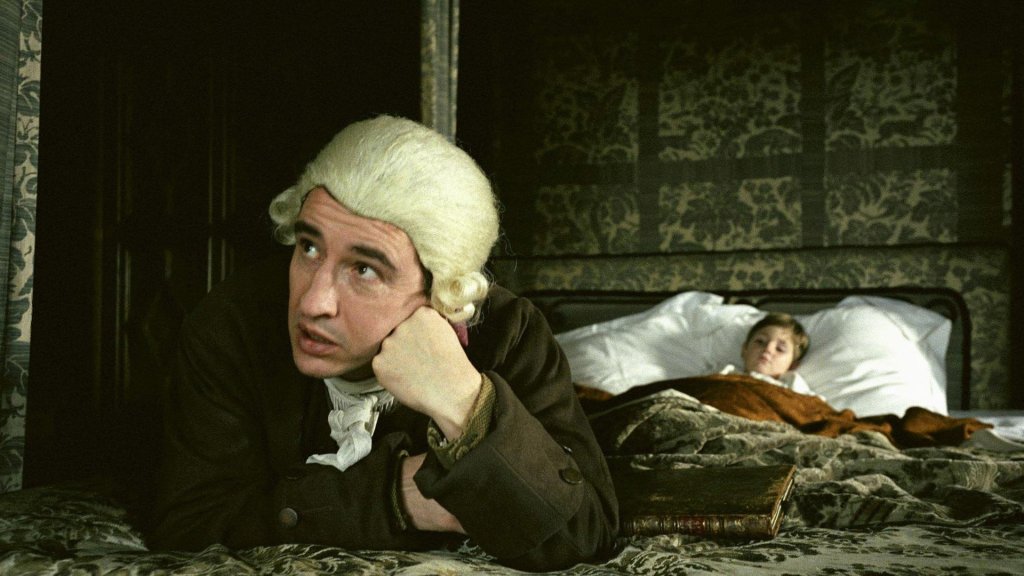
A Cock and Bull Story

Michael Winterbottom (UK, 2006)

Steve Coogan, eh? While any artist or craftsman hates being associated with one piece of work for his whole career, it seems he will never escape the long shadow cast by his Alan Partridge character, possibly the finest British comedy creation of the nineties. Let’s face it, he’s infinitely preferable to the bloke who says ‘nice’ on The Fast Show, the bloke who says ‘great’ on The Fast Show (OK, anything on The Fast Show)… what else was there in the nineties? Brasseye was great, but was lacking what one could honestly deem a singular ‘comedy creation’. Maybe I’ll think of something by the time I finish writing this.

Anyway Partridge was awesome, but that programme’s general greatness makes everything else he’s done since look a tad mediocre. To be honest, I can’t really cast judgement on Around the World in Eighty Days or The Parole Officer, as I could never bring myself to watch them. Saxondale was pretty poor even on its own terms: the first episode had a nice climax, but it just meandered in a joke-evading complacency for the most part. I didn’t even watch the whole series which, when you consider our series tend to be six episodes long, is pretty damning an indictment. Still, it was miles better than Lead Balloon, but you’d kind of expect that, Coogan being generally infinitely better than Jack Dee.

Coogan’s Run, and it’s various spin-offs, were good, but they predated Partridge anyway, I think. They certainly came along before the classic I’m Alan Partridge (better than The Office, in case you were wondering. Which you weren’t) redefined who Coogan was in the eyes of the public. His scene with Alfred Molina in Coffee and Cigarettes was a highlight of that film, along with Tom Waits arguing with Iggy Pop, and ‘Bill Groundhog Day Ghostbustin’-ass Murray’, but was a bit weird when I finally saw it. See, it eventually crawled onto the Victorian screen of the Hyde Park Picture House just after I had seen Spiderman II. Therefore, the sight of Coogan acting superior to the antagonist of that year’s biggest blockbuster was rather harder to believe than if I had seen the scene when it was originally released.

I suppose all that brings us to this one, made in 2005 but released in early 2006. I remember really wanting to see it at the time; maybe the rather under-loved second series of I’m Alan Partridge had just been on or something. Not wanting to read anything about films I intend to see, I’m not sure what the precise media tone was on it, but I recall a general underwhelmed feeling emanating from various magazine and newspaper pages.

And I can see why, really. The film abandons traditional narrative (or at least what an unsuspecting viewer would have been expected) rather quickly, as the tale of Tristram Shandy* is dropped in favour of meta-narrative on the making of the film about Tristram Shandy. When the film began, with its opening scene of Coogan and ‘supporting actor’ Rob Brydon in make-up, I simply assumed that was a neat little prologue. Instead, it was the introduction to the film proper, of which the actual tale of Shandy was mere digression.

I like the idea of this a lot, especially as Coogan and Brydon have pretty great chemistry (the really rather good Cruise of the Gods seems woefully unnoticed in the annals of telly comedy); Coogan is excellent as the Alpha Comedian constantly belittling his sidekick, Chuckle Brothers style. Actually, it wasn’t all one way: while ‘Coogan’ (the character, see) went to great pains to convince ‘Brydon’ that he was a supporting actor rather than a co-star, the latter irks the former by suggesting their names go alphabetically on the marquee, and regularly does impersonations that are allegedly of Coogan, but are really exaggerated Alan Partridge impressions. See, it’s that thing about not being able to escape the shadow of Partridge again, only all self-aware. Like the Simpsons episode with Rupert Murdoch in, it’s a slightly contrived effort at showing we great unwashed that he can laugh at himself. A-HAAA!

I just don’t know with this film. One the one hand I was pleased it stopped being the quasi-bio of Tristram Shandy, on account of it wasn’t very funny, I can’t stand Dylan Moran, and the narration kept stuttering when he was about to be born (which I gather was the gimmick of the book; he wasn’t born by the time it ended. I think). Still, Keeley Hawes was rather fetching. Anyway, the narrative soon shifted from the book to the peripheries of making the film of the book, in which lots of luvvies were knocking about in an old castle mithering about various details of the production. The only problem here was that this wasn’t particularly amusing either.

It seemed to be a vague stab at making a feature length British equivalent of The Larry Sanders Show which, in a way, the Alan Partridge stuff was anyway. And it just wasn’t venomous enough to really compare to Sanders. Apart from the aforementioned relationship between Coogan and Brydon, and Coogan’s Partridge albatross, I suppose the other source of entertainment was found in the recurring motif of people having what they thought were really good ideas, only to find them completely excised from the final cut. Among these were battles that were largely derided by all involved anyway and a role played by Gillian Anderson, for which they actually used Ms. Anderson (complete with someone wondering aloud whether she’d been in Baywatch), in which she appeared, talked a bit, then complained about not ending up in the film.

I was checking on the time about half an hour into this one, which wasn’t a good sign, and I am torn between the two reactions of respecting A Cock and Bull Story for its structure and resenting it for the structures lack of success. I, to this day, am unaware of what it was trying to achieve; I do know, though, that it wasn’t funny enough to pull off such a random exercise.

One scene that I did find rather touching was the one in which Coogan was interviewed by the late Tony Wilson (of course, Coogan played Wilson in the 2002 film 24 Hour Party People); I assume they showed the film because of Wilson’s recent passing but, if that was indeed the case, I don’t know why they didn’t just air the latter instead. Whatever, it was poignant and reminded me of the time I ate a few tables away from Wilson in Manchester in late 2000. and that’s about it, I suppose. The bit-parts weren’t very engaging (including some dolt from The Fast Show), it meandered without ending up anywhere, and I can’t even remember how it finished. ‘Great’.

* I admit to ignorance on this one, not having read the book prior to watching the film. And, as I watched the film the other night, I still haven’t read it. Or pretty much any book.

POSTSCRIPT: I knew I forgot something. I did find the scene where Coogan was lowered into a giant fake womb to be rather amusing, as was what I think was a dream sequence in which he appeared again in the womb, this time a normal-sized one, and started ranting at the rest of the cast. The highlight of this was the most Partridge line of the film; on the surrealism of his situation he squeaked ‘I don’t know why I’m so small!’

Slowly Getting Converted

As time goes on, my resistance to dubstep weakens. I never actually disliked it (I gave Boxcutter and Distance the dread download treatment, and liked what I heard), but was a tad sceptical. I was especially sceptcal of Burial; I just didn’t see what all the fuss was about, and certainly didn’t sympathise with the ‘this is the ultimate statement of urban life!’ hype.

I wrote on a message board a short while back:

…[T]he depth of the image he creates finally comes into view. Fuck the ‘this is the sound of London, doomed megalopolis, post apocalypse, hauntology!’ accepted line of thinking, this is a pained (‘Wounder’, ‘U Hurt Me’), personal document; disc 2 is as mournfully blissful as anything I’ve heard. It’s like a black and white Vespertine, stripped of all joy or character; but that core, that dishevelled, drained, cadaver within is just as affecting in its diseased humanity laid bare.


And it just keeps growing on me. The moment of clarity was obviously hearing it on double vinyl, but there is also an element of slow-burn at work.

Anyway, another day, another step into the the subterranean depths of dubstep. Wandering downstairs in Crash Records, a thorough look revealed a bunch of Skull Disco records. Sadly not Majestic Visions, which is what I was most after, but they had another Shackleton/Appleblim (pictured) and also the Villalobos remix of ‘Blood On My Hands’ (quite literally not pictured). So I got those. I have thus far only listened to the former, but was sufficiently impressed to pen this little post. While I hae historically preferred Appleblim, I have to admit it is Shackleton’s ‘Hamas Rule’ that impresses most, with its Middle Eastern melodies, sparse darkness and what must be the biggest bassline in my collection.

I would also like to mention the artwork, reminiscent of Pushead, lending the existing dark underground aesthetic an added sense of old school metal/crust nastiness. Excellent.

Garden State

Zach Braff (USA, 2004)

I wasn’t all that hyped for this, to be honest. The second film I had seen in Film Four’s current ‘New Hollywood’ season, Garden State’s description as ‘written by, directed by and starring Zach Braff’ filled me with trepidation. It’s not that I don’t like him – he’s a perfectly fine comic performer in Scrubs (even if he’s not one of the funnier on the show, those being Neil Flynn, Donald Faison, John C. McGinley and Ken Jenkins in descending order) – but I didn’t like the idea of his having a vanity project. So: did it turn out to be a vanity project with little to redeem it, or could Braff prove me wrong by turning in a great film?

Go on, guess.

In case you were actually wondering (and are one of the four or so people in the western world who hadn’t see the film before me), it was pretty dismal. I remember someone I don’t like once remarking that Garden State epitomised what he hated about modern American popular culture. I, not liking him and all, decided that I would like it on principle. I was wrong. Garden State is a feeble, feeble example of film-making that I only endured for its entirety because I want to get into the swing of watching (and, unfortunately for you lot, writing on) more films.

I can’t discern what it was Braff was aiming for in making this film. I saw no real message, other than perhaps some vague stab at ‘live life to the full please’; there was pretty much nothing in the way of character development, save for ‘I was on anti-depressants and now I’m not’; the dialogue was weak; the cinematography was no better than adequate; perhaps most criminally, there was no conflict or drama in any meaningful way. The silver lining, I suppose, is that my DVD want list now has one less title on it.

In defence of the film, its somnolent delivery and dreary pace could be seen as allegory for modern life itself: the very lack of emotion or character at the heart of the film (a pretty damning omission, as this was ostensibly a character driven piece) a cinematic representation of life while tranquilised. While I am happy to give Braff the benefit of the doubt on this one, it’s not like such method makes for compelling film-making. One would have hoped that such a message of ‘live life instead of being medicated to the eyeballs!’ would be represented by a celebratory, exciting film, but apparently not.

Instead, viewers of the film were subjected to nearly two hours of the most anodyne indie pop music imaginable, the candy-coated dirge pausing only for witless dialogue and stumbling, bumbling narrative. The ubiquity of the music (fittingly empty of emotional or intellectual content) was so blatant that one character actually made another listen to The Shins on headphones; it was a ghastly experience. Fortunately, there was a scene sound-tracked by Nick Drake, which was a definite upturn in fortunes. In fact, that was quite easily the best scene of the film, as it was visually far less mediocre than the rest of Garden State’s cinematic mire; I should try riding with my feet up in an antique sidecar while ‘One Of These Things First’ plays.

Speaking of the headphone scene, I suppose now would be the best time to mention the second most prominent actor in the film: Natalie Portman. Watching the film, I was for some reason reminded of the trailers for Lost in Translation, another film everybody but me has seen (to incredibly divisive effect); I had missed it due to hitting the bars that night, and was ruing having to watch Portman instead of the pink bob bewigged Scarlett Johansson (as well as wishing I had stayed out longer on this night). I then remembered that Portman wears a pink bob in Closer, so I shall have to get that done in due course. That is not to say la Portman is not an attractive person, because she is. Sadly, she is also intensely annoying in this film, but I will gladly attribute that to Braff’s cack-handed writing non-ability.

Otherwise, the cast was a set of ghostly archetypes and stereotypes, never to pass into the realm of credibility. The story, such as it was, concerned jobbing actor Andrew Largeman (Braff) returning home to New Jersey to attend the funeral of his mother, a paraplegic due to a household accident caused by a childhood Andrew. While there, he goes to a party where people take Ecstasy and make out (think that scene on the barge from Peep Show, minus the comedy and self loathing, plus smugness), and generally knocks about with the slackers with whom he grew up. He meets Sam (Portman) in the doctor’s and falls in love with her. He also sort of talks to his dad about his mum, with little in the way of resolution.

Maybe I’m just jealous that I haven’t met Natalie Portman while wiling away my time in waiting rooms, but she seemed a tad off. Apart from the painfully trite words Braff placed in her mouth like so many cylinders of pre-filling dental sponge, she seemed unwholesomely young for the donkey faced Braff to be getting off with. And I don’t even know why – this was a good half-decade after she had played a young queen in Star Wars, after all. There was also a nodding, winking self awareness to the film, which made the complete lack of wit even more pointed. Sam spouted annoying teen cliché about how weird she was, and how freaked out Largeman must be in her company, apparently only so Largeman could point out the fact that she was doing it.

There was to be no great conclusion to this meandering, other than Largeman deciding to be with Sam rather than return to California. It was like the end of Friends but stripped of any drama or the years of viewing that had invested a level of emotional attachment to Ross and Rachel. The narrative overall, of a quirky girl who brightens up the life of a dullard, was like Le Fabuleux destin d’Amélie Poulain, told from the opposite viewpoint, with infinitely less charming cinematography, setting, characters, performers and plot. There were two more elements of silver lining to this drab, cultural cumulonimbus: the title ‘Guardian of an infinite abyss’ was a nice line and, were it the film’s title, should have invested it with at least a modicum of mystique; and the presence of Method Man. He is awesome, and I never realised he was so tall.