
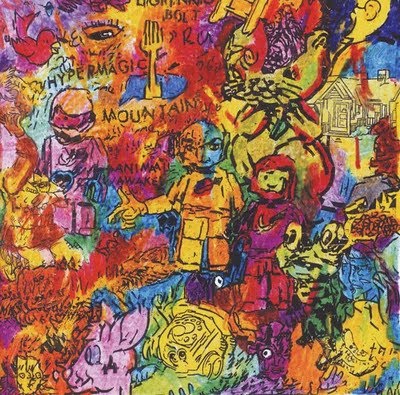
Hey! Remember the 2005 project? Well, I put the kibosh on it because, well, I didn’t get my act together quickly enough and, let’s face it, nobody wants to know what your top 50 of one year is. I like to think it was endearingly quixotic. Anyway, there were some write-ups that I completed that didn’t end up on here at the time. And, seeing as I just wrote about the new Lightning Bolt album, I figured why not publish my thoughts on the record directly preceding it? So here we are. This does not mean I will suddenly stick all those completed reviews on the blog right now. That’s because I have an even more ‘endearingly quixotic’ project in the works, of which this album is most likely not a part. Can you guess what it is?! Ooh, exciting innit.
[As this is old, and part of the 2005 project, there will probably be references to that. And recent events that are now dim and distant. Please excuse these. I’m not editing them out, as I like the historical artifactitude of it all. At which number would this have been, pop-pickers? Funnily enough, it’d likely only have been one or two places above this one, the last post made while 2005 project was still alive. How weird! Anyway, here we go.]
***
I want to stick this album higher than I have done, but there is a flaw preventing me from doing so. Before that, I would like to focus on the many positive attributes Lightning Bolt brought to the table in the oh-five.
For those who don’t know, Lightning Bolt are an incredibly energetic power duo from Providence, Rhode Island, and signed to Load Records, home to many energetic American power- bands. The unifying theme of the label essentially consists of DIY-sounding, angry (but in a fun, rather than angsty, way), noise-rock bands with a definite punk rock sensibility. Check it out for it is, along with Crucial Blast (Genghis Tron [they’re now on Relapse – me, in 2009], Skullflower, Geisha etc), where it’s at for modern noise rock at the moment.
Hypermagic Mountain is the fourth album from this fuzzed-out rhythm section, and it is epic. But when I say ‘rhythm section’, this is not a detail easy to infer from listening to the music, for it is intensity in Ten City. The bass is distorted almost beyond recognition, and sounds very high, almost like a normal electric guitar. This, coupled with Brian Gibson’s virtuosity on the bass – able to hit rhythm, riff and solo like he was ringing a bell – legitimately remind me of the late Cliff Burton, Metallica’s second, and pretty definitely most well-loved, bass player.
The drumming is equally fantastic. Like Gibson, skinsman Brian Chippendale plays like everything is a solo, but with such rhythmic precision and visceral impact that the listener is never left resenting such a display of technical skill. It is this combination of immense technical acuity with punk attitude and compositional skill that has led them to be described as both punk rock and prog rock, a laurel few bands can boast.
The ‘punk’ aspect is evident in the rough and ready delivery of the music, as well as their frenetic live shows and overall aggressive sound. The prog aspect, though I would not use the term to describe them, is more justifiable now than ever before. The crazy time signatures and song construction sounds like it has more in common with the improvisation of free jazz than the planned-out prog, but that depends on how the Brians write their songs. So that angle is possible, though debatable, even with the recent more towards ten-minute songs (‘Dead Cowboy’ and ‘Mohawk Windmill’ take a bow). More compelling is the nomenclature they give their music: albums called Ride the Skies and Hypermagic Mountain, as well as songs like ‘Infinity Farm’, Dracula Mountain’ and the excellently-monikered ‘Crown of Storms’ suggest a penchant for fantasy/flights of imagination in keeping with a lot of prog.
Anyway, this album is pretty brilliant. ‘Magic Mountain’ is especially notable for its almost unbearable rising motif: the bass slowly, jaggedly, crunches up the gears as though it was a particularly testy Mitsubishi GTO, while the drums punctuate each grind, as the music rises and rises. Up, and up, new gear; up and up… there is brief catharsis in rock-out, but soon the duo is back to the building, building, tightening that elastic band til you think it’s gonna snap. It goes higher and higher, with a drone now in the background, building and building, and it explodes again with a minute left in the song! But it’s still building. Then the bass-line gets stuck in a circular pattern, as though their car was stuck in mud. Now it’s upper register bass loops as the GTO struggles with all its might to get out of the mud. The bass/engine is whining in the upper register, sounding like a guitar, and the tensile strength of the tune is being taken to its very limits. And then – it stops.
Sadly there comes a point, admittedly on track nine (of twelve) where the flaw hits you: there is just too much. My idea of great punk/hardcore/Noisecore albums is that short sharp shock effect. The best Dillinger Escape Plan release is less than eight minutes long. My favourite album of 1999, the Coalesce swansong [not a swansong any more! – me again], is twenty-three minutes. The problem with a release of this type being so long is that, rather than being shocking and awesome, just becomes slightly fatiguing. Worse, you get desensitised to it. When you’ve had eight tracks of this excellence, a ten-minute song is not what the doctor ordered – unless it is a complete change of pace.
So that is the issue with what is otherwise an absolutely scintillating album. It’s a shame, because the album directly prior, Wonderful Rainbow, was shorter and didn’t get old, so you can infer how awesome this could have been. I really want to tell everyone to rush out and get this, so buy …Rainbow instead; you’ll get the idea.


 throughsilver in blog