If on a winter’s night a traveller

I’ve been meaning to write about books. Partly because I am actually finishing books now (three done in the last year! Which is good by my standards). So I’ll aim to get those written about.

This one is confusing. And it’s actually not one of the three I’ve finished. I’m about a third of the way through, and it’s hard work. I don’t know if this style is standard for Italo Calvino, as I’ve not read any of his other work. So what is this style?

The book starts off by addressing you, the reader. It goes on, in conversational style, about how you go about reading the book. And then it starts the book. But you get a chapter in, and it turns out the book Calvino tells you you are reading is jumbled up with another book. So you start reading that, but there is an issue with that new one, and so on, until you’re fifty pages in, and you’ve read excerpts of multiple books, while also being told in excruciating detail, how you feel about it, which courses of action you could take, which you do take, and planting the seeds of a meta novel, in which you are awkwardly trying to form a romantic relationship with a woman who is also struggling with the novel.

Some of the stories are discovered while “you” are trying to find out which books you were accidentally reading. You ask a professor of some dead language if he know of a book with these characters and those places in. He says yes, but then you’re given something completely different. Any time you think you’re getting into one of the books, you’re given another, whether you like it or not. Because whether you like it is not the point.

So what is the point?

Well, it’s a very clever essay, on the nature of writing: what is a novel; how do we engage with characters, scenes and settings, and how does an author work to make that happen; what was going on with the author as artist in the late 70s vs pairs or groups of writer, and how pure fiction compared in popularity with non-fiction; how language itself evolves or else dies; how clever Calvino is.

And it’s the latter element I’m getting at the moment. Given that the novel is from 1979, there’s a definite feeling that If on a winter’s night… is a prog rock album of the world of written fiction. Lots of changes, metatextuality, breaking the fourth wall, and seeing if you can keep up with his scattergun combination of critical theory and conflicting narrative.

I got a bit stuck on one bit, a war story-come-erotic fiction. It lost me a bit. But now I’m back in the “real world”, so I guess I’ll plug on. But I’m writing this in case I don’t finish; I want it to be clear why I didn’t. I’m also super late for a book club discussion (by weeks), so I just want to log some analysis of the book somewhere.

Scott Walker

Part of getting old is dealing with people dying. Thankfully, this does not include people very close to me, but celebrities I am fond of have been dying at an alarming rate. They’ve been really good ones, especially musicians. I’m not the biggest Bowie fan, but I get that he’s a legend of course.

But the personal ones that hit me the most were Prince and Chris Cornell. Both prescription drugs, as I recall. But they both played music that touched me. Honestly, take a moment to listen to these:

Soundgarden – Fell on Black Days
Prince – Little Red Corvette
Audioslave – Like a Stone
Prince -Purple Rain

Of course, both also did sexy, high energy music as well. But that’s the kind of stuff that really touched me over the years.

Anyway, this isn’t really about them. They both died a couple of years ago now. More recently – after I was already pretty thrown by the untimely demise of Keith Flint – Scott Walker died.

Who was Scott Walker? Well, here you go:

In a nutshell, nobody else in the history of recorded music has someone been in a band that was as big as the Beatles, split them up at nearly the height of their powers and gone on a run of magical psychedelic masterpieces, before then reforming the band and putting out music that would influence Bowie’s best era, and spend the last few decades of is life releasing legitimately challenging, artful pieces of music.

In the mid 90s, he was up there with the best younger artists, like Tricky, Massive Attack or Swans. In 2006 (yeah, he averaged an album per decade for a while), he released The Drift, which was my real introduction to him. He was so in tune with experimentation and darkness that he was a key part in what I think was the best sunn(o))) album, Soused. And, for the whole time that he was releasing music, his singing was impeccable. Like, seriously brilliant. I suppose because he refused to perform live and made albums at glacial pace.

Who else has there ever been like Scott Walker? He was initially not even a singer, opting to be the bassist in his first band. Thank goodness someone decided that a ballad required his deep voice. That decision pretty much changed “pop” music forever. We’re all going to miss him.

Still years, after all this crazy

I’m still ageing. And I’m still wondering what’s going on with regard to music. Specifically how I interact with it. How we do. Whats going on?

I was thinking yesterday about when we would listen to music when we were younger. Remember hanging out with your friends, before everyone had careers and children? You’d just pop round, sit in the kitchen and chat while having some lunch, or trying some skateboard tricks, or reading Kerrang! magazine.

And while we did those things, we’d put on a tape or a CD. And that was how we listened to things, and got into albums. Even stuff I didn’t particularly care about – the first Millencolin and Mr Bungle albums. All the bands that sound like Bad Religion. Anything by Ben Harper or Primus. They weren’t anywhere near my albums of the year in, well, any year. But I knew – and know – them as well as any of my recent favourite albums of the year.

We’d just put that tape on, and it would osmose into our consciousness. Nowadays, if I do get together with my friends, and we don’t happen to be out, we end up talking about our lives, but with no music in the background! Or if you’re just hanging out, there is so much more on TV – and more easily accessible – that I think we opt for that. In 1997 while there was Sky and cable, quite often my friends would have five channels. Especially during the day, there would be nothing on. So, once we were bored with Mallrats or skate videos, we would listen to music.

Of course, we can listen to music now. More easily than ever before, in fact. But is that ease of access part of the problem? You’d either listen to the one album you could afford to buy that week (or month), or else whatever you managed to tape off your friends, if you had a blank tape to hand.

Now you can listen to anything on YouTube, or Spotify or your NAS drive. So what do you pick? That leads you to the meta-question that I still really need to address (in a future post): what is there?

You know, it’s the standard question that any ageing person has asked (including Seymour Skinner), that of whether I am out of the loop of is music just not as good as it was? And if it’s not, why not? Rock is pretty much dead, as a concern that is developing and growing. So any rock that does happen now is inherently retrogressive. Hip Hop, techno and pop all seem to have homogenised into one auto-tuned procession of club beats that has for a few years reached the pomp and bombast of the worst excesses of mid-70s rock, but while assimilating and consuming any punk equivalents rather than those overcoming it. But like I say, that needs really thinking through.

This post is mainly about the method of delivery, of the paradoxical combination of not having the chance to have music on in the background and having too much music to choose from at any point in time. I guess that also feeds into the surfeit of anything new. We used to crave the new because the old was in the past. But now, AC/DC, Nirvana and Led Zeppelin are as relevant as any current music. Even though they themselves were arguably from different generations.

Anyway, that’s that for now.

UFC: fight night 148

I’ve not written about da fights in a while. Rather than try to write a whole article, I really just want to make some notes so I can remember what happened. Back in 2004-5, it was easy to remember what happened in a show, or who beat whom. Now, there’s pretty much a show a week, and everyone is beating everyone else.

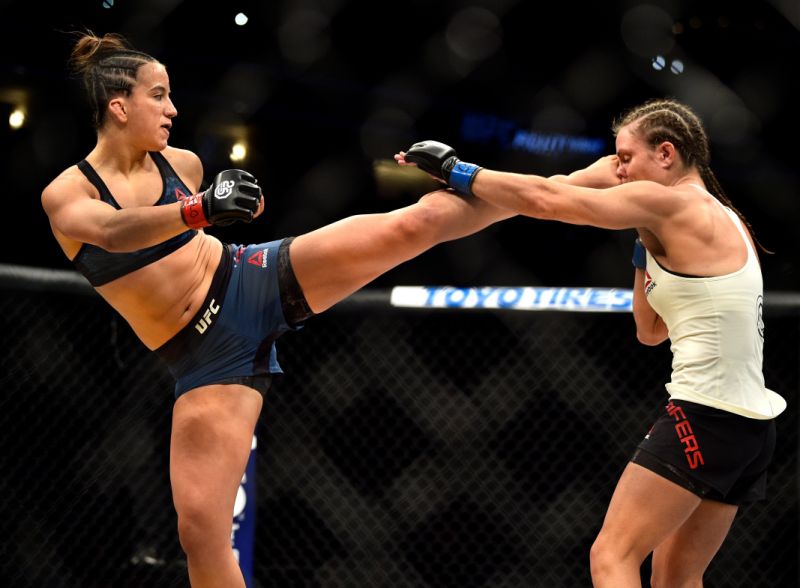
Maycee Barber does the biz. Err, in November, judging by the shorts.

So in this one, I was very surprised that Stephen “Wonderboy” Thompson suffered his first ever knockout defeat against an Anthony “Showtime” Pettis who was making his welterweight debut after a career spent at lighter weights. Watching the fight, you could see that Thompson was not only the naturally bigger man, but was using his modified karate style to strike Pettis pretty much at will from distance.

After the best part of two rounds of Thompson dominance, Pettis defended a side kick from Wonderboy before hurling a superman punch right into his mush. At first it looked like he’d used the cage wall as a springboard, but his own momentum was enough to send Thompson flying, before a bit of ground and pound finished the job.

The drama of the finish was quite surprising when you consider Thompson has lost to Tyron Woodley and Darren Till without being separated from his consciousness, but there you go. Maybe he’d had one too many blows to the chin over the years. Or maybe, as Wonderboy himself surmised, the accuracy combined with their positions to brew a perfect storm. Either way, Pettis returned to his tradition of finishing opponents, and looks like a decent prospect at the weight – even if he didn’t outperform Wonderboy for the duration.

What else happened in this show? Co-main was a heavyweight Curtis Blaydes using his wrestling to control fat guy Justin Willis and, well, pretty much nothing else. Man, how did Willis beat Motion Mark The Duster Hunt?! He had nothing for Blaydes. And while Blaydes did what he had to in order to get the win, it didn’t seem like he was going for a finish. After getting mashed to a pulp by the terrifying Francis Ngannou in November, he may have been a bit gunshy. Conversely, he should have tried to look good in his rebound fight.

Elsewhere, John Makdessi walked out to ‘Breathe’ by the Prodigy en route to beating Jesus Pinedo. Ledge.

The other key fact was Maycee Barber continuing to look impressive at age 20. After killing Hannah Cifers stone dead in November, she overcame some adversity courtesy of JJ Aldrich by stopping her in fine style with a nasty looking elbows and fists combo. One to watch, for sure.

Main players: Anthony Pettis and Maycee Barber.